
ILW25 Panel Reflection: Does Investment Arbitration Impede Climate Change?
by Chioma Menankiti, an LLM candidate at Harvard Law School*
This blog is part of a series of reflections on ILW 2025 by our Student Ambassadors. Each Student Ambassador engaged with various panels and will share their experiences in the lead up to ILW-West 2026.
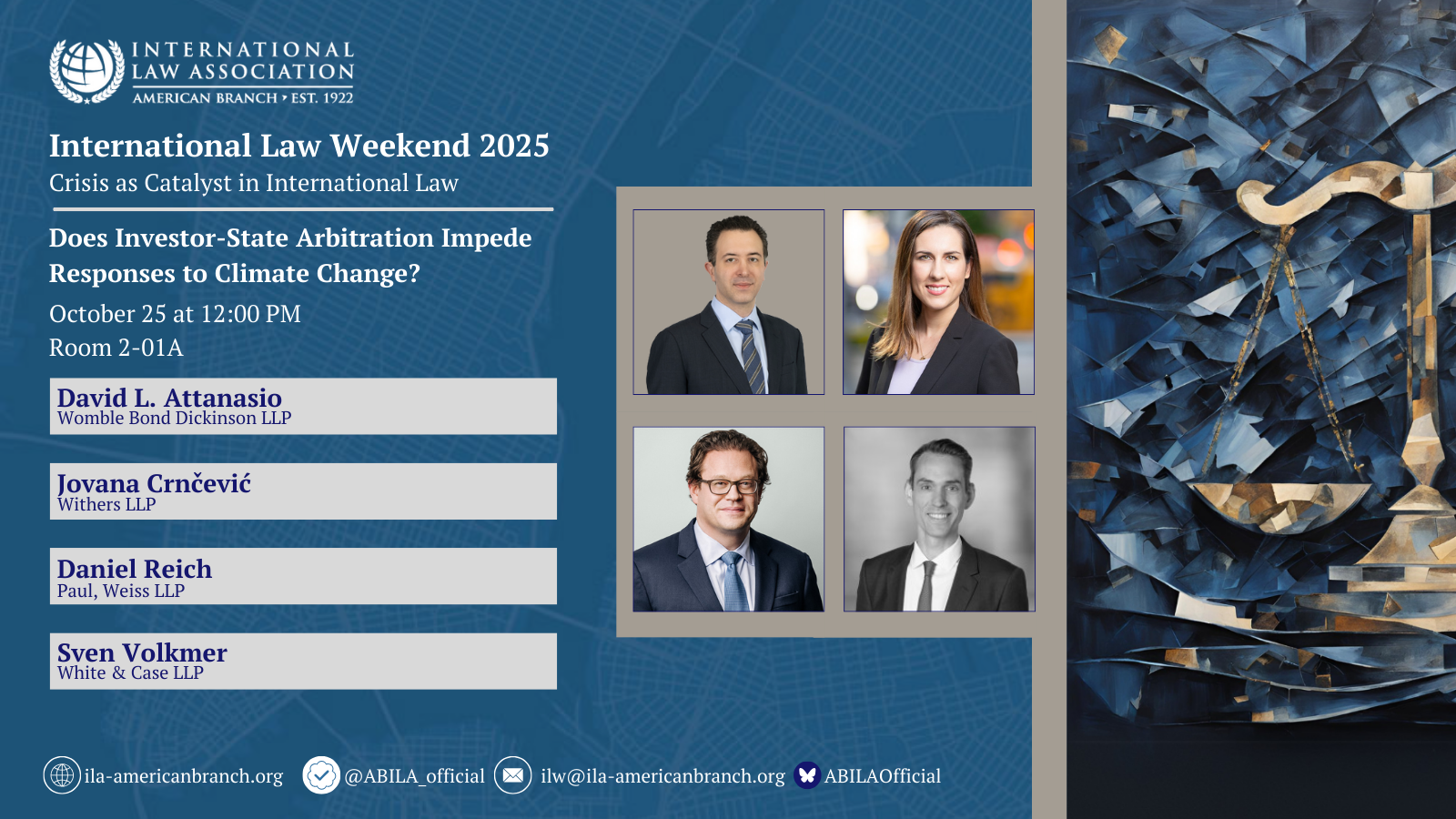
From the growing wave of states renegotiating bilateral investment treaties to critics decrying the expanding powers of arbitral tribunals, the international arbitration landscape is undergoing rapid transformation. Meanwhile, international bodies like the United Nations Commission on International Trade Law and the Organization for Economic Cooperation and Development push for multilateral treaty reforms, and a surge in renewable energy cases against European countries further fuels the debate. With these developments reshaping the conversation, four esteemed panelists gathered at International Law Weekend to tackle a critical question: Does investment arbitration, as it stands, hinder or help efforts to combat climate change?
David Attanasio, partner at Womble Bond Dickinson and Co-Chair of ABILA’s International Investment Law Committee, opened the discussion by providing context on recent criticisms of investment treaties and the European Union’s efforts to modernize the Energy Charter Treaty (ECT). Given the ECT’s role in providing “a multilateral framework for energy cooperation,” he underscored the importance of these reform efforts in combating climate change by reducing protections for hydrocarbon investments and expanding exceptions for regulatory measures aimed at environmental protection, which in turn helps counter regulatory chill. Additionally, the reforms aim to terminate the ECT’s protections for new fossil fuel investments while phasing out protections for existing investments. According to Mr. Attanasio, these substantive modifications were implemented with the understanding that investment arbitration poses a significant barrier to climate change mitigation. The rationale is clear: investors challenge climate change regulation through investment arbitration, thereby discouraging states from enacting legislation in this area.
Having set the stage for an engaging discussion, Sven Volkmer, a partner with White & Case’s international arbitration practice, provided an overview of the types of climate-related state actions that have given rise to investor-state dispute settlement (ISDS) cases. Mr. Volkmer’s discourse centered on three notable categories of disputes. The first category involves disputes arising from states’ efforts to phase out fossil fuels, as exemplified by Rockhopper v. Italy. Brought under the ECT, this case concerned a ban on oil production off the Italian coast and a subsequent denial of the British claimant’s oil concession, despite the claimant having completed exploration and steps to secure the concession. While the tribunal in this case ultimately sided with the claimant, it acknowledged the tension between the state’s right to regulate and its obligations under the ECT.
The second category addressed disputes arising from states’ decisions to scale back renewable energy incentives, such as in the recent cases against Spain. The third, albeit smaller, category concerns disputes triggered by inadequate state action to protect the environment and address climate change. An illustrative example is Allard v. Barbados, in which the claimants, who had invested in an ecotourism project, argued unsuccessfully that the state had failed to uphold its environmental protection commitments.
In light of the growing number of climate-related investment disputes, Jovana Crnčević, Special Counsel (International Arbitration and Public International Law) at Withers LLP, weighed in on whether the ISDS mechanism is fit for purpose. She highlighted the paradox of expecting states to take decisive action on climate change while risking paying investors billions of dollars in damages. Moreover, with ICSID reporting record numbers of international arbitration disputes, an increasing share of which pertain to the oil and mining sectors, there is little doubt that investment tribunals will be continuously summoned to adjudicate these disputes. Ms. Crnčević then examined efforts to address the asymmetry between investors and states, particularly through host state counterclaims. She noted that the requirement of a manifest factual connection, as well as some treaty language supporting counterclaims, has produced mixed results in enabling states to bring counterclaims against investors.

She continued, citing several notable examples: the tribunal in Urbaser v. Argentina confirmed that states can bring counterclaims, while in Burlington v. Ecuador and Perenco v. Ecuador, the arbitral tribunals factored investors’ environmentally detrimental actions into their cost assessments. These cases, she concluded, suggest a likely increase in states’ use of counterclaims. Another effort by states involves embedding, in new bilateral investment treaties, explicit rights for states to regulate on environmental matters, reinforcing states’ continued cooperation on climate change mitigation. These actions also have the secondary effect of giving investment tribunals practical experience with climate-related and environmental issues. As a result, arbitral tribunals may increasingly be called upon to address unique and intricate factual situations, making investment arbitration better suited to adjudicating climate-related disputes.
Afterwards, Daniel Reich, partner at Paul Weiss’s international arbitration practice, opined on whether the wider community should be concerned about ISDS and how international arbitration can contribute to combating climate change. He noted that, despite its flaws, the ISDS system does more to support climate change action than to hamper it. In addition to its traditional goals of avoiding conflict and promoting economic development, and contrary to the regulatory chill criticism, he stressed that climate change can, in fact, encourage green investment. Tackling climate change requires investing in the green economy, and for states to attract the foreign capital necessary to meet their climate objectives, investors must be confident that their investments will be protected. Mr. Reich argued that ISDS remains the most effective mechanism for providing such protections and observed that it has not resulted in substantial regulatory chill. He emphasized that, although ISDS can lead to sizeable awards, this should be viewed in context: states prevail in the majority of disputes, and they typically adhere to their international legal obligations without triggering arbitration. Moreover, with no feasible alternatives currently available to address the urgent climate crisis, systemic reform is necessary.
In a bid to tie their contributions together, the panelists discussed the impact of the International Court of Justice’s recent advisory opinion, which reiterates states’ duty to undertake actions to curtail the harmful effects of climate change. They concluded that this opinion, although not binding, exacerbates tensions between states’ obligations under investment treaties and their international climate responsibilities. The panelists also explored how national law can impede state responses to climate change, citing Vattenfall v. Germany as an example. In this case, the German constitutional court held that the government’s rapid policy shifts in the area of nuclear energy policy violated the investor’s legitimate expectations, similarly to the protection guaranteed under investment treaties. The Vattenfall case, according to the panelists, emphasized the broader implications of state responses to climate change, illustrating that domestic legal systems can offer investor safeguards similar to those provided by investment treaties in the context of climate change.
Having covered several salient points on whether investment arbitration facilitates or hinders climate change efforts, the panelists opened the floor for questions that spanned the breadth of their contributions. Their responses resounded with a clear message: so long as investment plays a key role in addressing climate change, an efficient ISDS system is essential. In the words of Mr. Reich, “reform is important, and we need to get it right.”
 *Chioma Menankiti is an LLM candidate at Harvard Law School. She previously earned a Master’s in Economic Law from Sciences Po Paris, specializing in Global Business Law and Governance, as well as a Bachelor’s degree in Politics and International Relations from the same university. Her professional experience at law firms and international institutions—including the OECD, UNCTAD, and ICSID—along with her participation in the Willem C. Vis International Commercial Arbitration Moot, has deepened her interest in international arbitration and investment law, particularly in investment treaty reform.