ILW25 Panel Reflection: Keeping Sinking States Afloat: The Crisis of Climate Change-Induced Sea-Level Rise and the International Legal Framework
by Vibha Bangarbale, JD Candidate at Case Western Reserve University School of Law*
This blog is part of a series of reflections on ILW 2025 by our Student Ambassadors. Each Student Ambassador engaged with various panels and will share their experiences in the lead up to ILW-West 2026.
What is a state? Ostensibly, the answer is straightforward: defined by the declaratory approach in the 1933 Montevideo Convention on the Rights and Duties of States. Indeed, the Montevideo Convention holds that a state is a “person of international law” if it has these four elements: (a) a permanent population; (b) a defined territory; (c) a government; and (d) the capacity to enter into relations with other states. Others may point to alternative theories, such as the constitutive theory of statehood, which holds that only recognition by other states creates legal statehood, rather than a set of elements. While various ideas of statehood differ in theory, most have historically relied on the assumption that a state will occupy its own established sovereign territory.
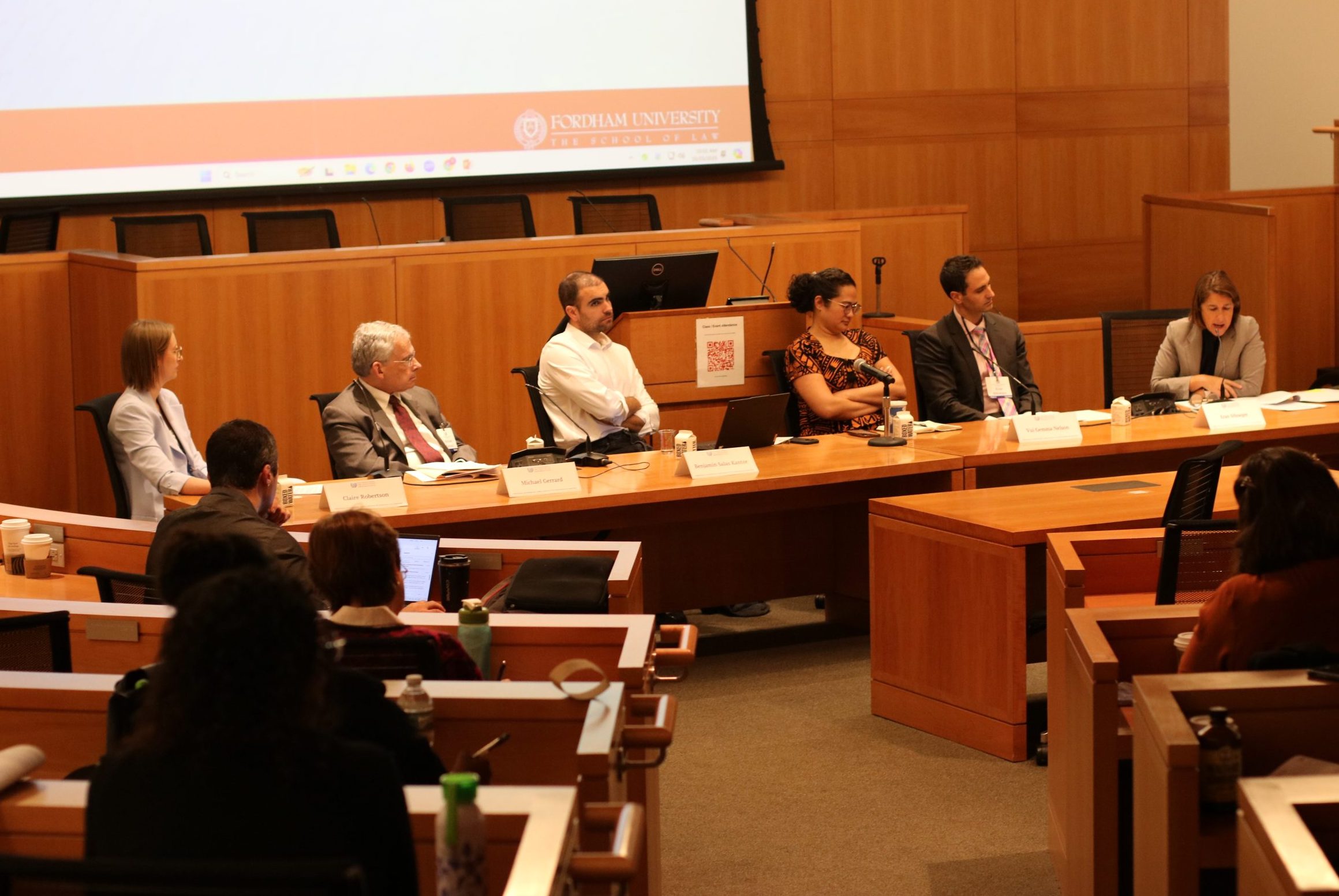
But how do we define a state when its established territory disappears before our eyes? What happens when a state’s former territory is destroyed and essentially uninhabitable? While there may be answers to these questions under international rules of war and conquest, can we say the same for climate change-induced sea-level rise? At International Law Weekend 2025, the panel entitled “Keeping Sinking States Afloat: The Crisis of Climate Change-Induced Sea-Level Rise and the International Legal Framework” tackled this complex issue. The panel of experts, including Michael Gerrard, Benjamin Salas Kantor, Vui Gemma Nelson, Eran Sthoeger, and Patrícia Galvão Teles, led by moderator Claire Robertson, discussed the future of recognition under international law for states at risk of losing territory to climate change. In particular, this panel sought to analyze whether climate change-induced sea-level rise should serve as a “catalyst” for changes to traditional frameworks of statehood. However, while discussing theoretical approaches to state territory loss, the panelists never lost sight of the human aspect of this issue. While states are at risk of losing power and standing on the international stage, it is the people living in these states who will lose the most.
Notably, Salas Kantor began his assessment by calling for a departure from strict adherence to the Montevideo Convention’s statehood framework. His key concern involving the current Montevideo system was that there are no definitional legal statehood criteria for states that permanently lose their territory. Instead, the Montevideo Convention treats the territory a state occupies as almost a key anchor in its claim to legal statehood. Articles 1, 9, and 11 all make direct references to a state’s territory in connection with its legal claim to statehood. It is almost as if the convention assumes that a state will not make a legal claim to statehood without territory. Instead of a declaratory approach, Salas Kantor posited that the international community should follow the “effectiveness” theory of state recognition. In this theory, a state’s effective control over factors such as its population or government will be the key to determining whether a state exists, rather than strict adherence to the four Montevideo factors. Under the effectiveness theory, a state would not lose statehood if its territory became inaccessible due to climate change. Sthoeger also described his assessment of the current international legal standards for statehood. In his view, when the traditional statehood factors are no longer met, this might not result in an automatic loss of statehood. In fact, there may be a transitional period in which the state retains its status while no longer controlling a territory.
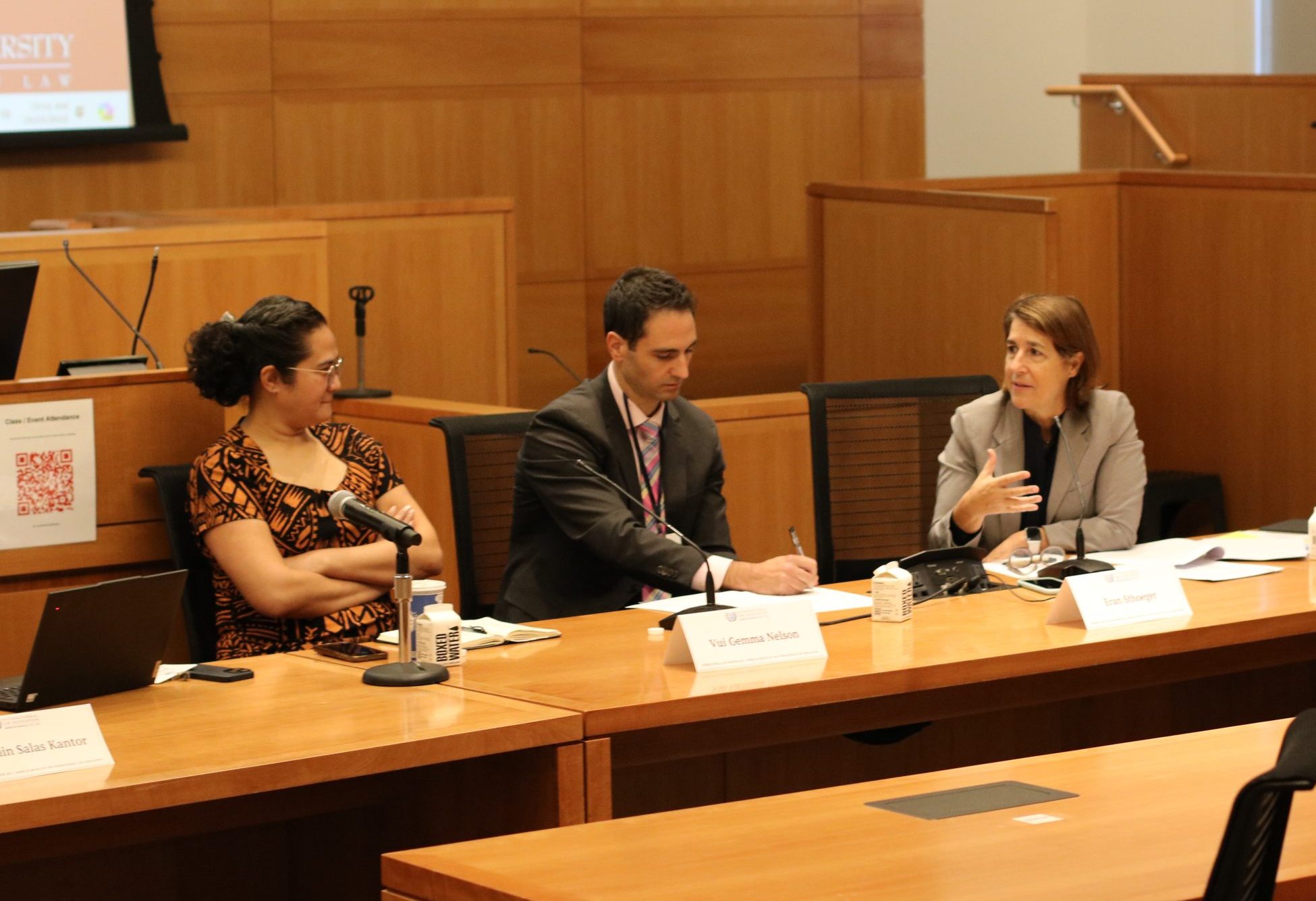
In contrast, Nelson emphasized the importance of fighting to preserve existing state territories, particularly for certain island nations. Nelson called specific attention to the cultural significance of the land for Samoa and the Samoan people. Samoa is an island state that is in danger of losing its territory to climate change, either through rising sea levels or related habitat loss. The word for “land” and for “blood” is the same in Samoan (‘ele’ele), Nelson noted, remarking on the deep cultural significance of the land to the Samoan people. Losing the island state’s territory to the effects of climate change would not only damage Samoa’s legal claim to statehood but also irreparably harm its people culturally. While forward-looking legal analyses of continuing statehood are useful, the international community should not abandon efforts to combat climate change’s effects and preserve existing state territory. According to Nelson, Indigenous rights and heritage should remain a priority for policymakers when making decisions related to continuing statehood.
Galvão Teles then discussed key takeaways from the International Law Commission’s (ILC) recent report on sea-level rise in relation to international law. The ILC began studying this topic after the U.N. General Assembly acknowledged and passed resolutions describing the existential threat of climate change-induced rising sea levels in several sessions between 2015 and 2024. The ILC concluded that state continuation practice, especially those related to climate change, is still developing. As a result, Galvão Teles noted, it is challenging to reach concrete legal conclusions regarding how this practice may operate in the future. Galvão Teles also observed that the Montevideo recognition factors describe a state’s creation, not necessarily specific state continuation practices when its territory is lost. As such, there is no international legal principle stating that states cannot continue to exist as legal entities even with partial or total submersion of land territory.
Following the discussion on the ILC report, Gerrard reflected on states’ continuity options for their populations in light of partial or total land submersion. One option would be to move the state’s population to another state that allows them to live within its territory. The submerged state’s citizens would have to somehow assimilate into the host country’s society and cease to be citizens of their country of origin. This would not be a continuation of the submerged state, but it would allow the state’s former citizens to survive. An example of this concept in practice, Gerrard stated, was in the 1980s, with many individuals from the Marshall Islands permanently resettling in Arkansas due to economic and environmental strife. Many of these individuals became U.S. citizens or otherwise assimilated into American culture to survive after being displaced from their home state.
Another method, Gerrard noted, would be for a willing host state to cede some of its territory to the displaced state. The displaced state would then move its citizens into this ceded territory and reestablish itself. Separately, Gerrard also reminded the audience of the concept of association with another state, in which two states merge their territories to create a single state combining both territories. Gerrard cited Zanzibar and Tanganyika’s 1964 unification as an example of this concept in action.
Gerrard’s proposed state continuation options prompted several responses from fellow panelists. Sthoeger highlighted the dependence of several continuity approaches on the goodwill of host states toward displaced populations. Galvão Teles and Nelson expressed concerns about inadequate protections for migrants, with Galvão Teles emphasizing the need to reform nationality laws and humanitarian visa processes. Nelson also raised questions about territorial equity, positing that host countries would relegate displaced populations to inferior lands, particularly noting that former colonizers would likely offer inequitable arrangements. As an alternative approach, Salas Kantor suggested implementing land lease agreements rather than permanent territorial transfers for resettlement areas.
Closing out the panel, Nelson reminded the audience of the International Court of Justice’s (ICJ) July 2025 Advisory Opinion. This opinion establishes that all states have a legal duty to mitigate climate change and prevent significant harm to the climate. In that sense, it is the legal responsibility of all states to collaborate and prevent these states from disappearing. Rather than focusing solely on post-displacement solutions, the international community must prioritize its collective obligation to address the root causes of climate change. The ICJ opinion ultimately underscored that while the legal frameworks for state continuation analyzed by the panelists deserve serious consideration, states’ primary responsibility remains preventing territory loss altogether.