ILW25 Panel Reflection: Negotiating the Future Crimes Against Humanity Treaty: Paradigm Shift or Half-Measure?
by Claire E. Barrington, J.D. and LL.M. Candidate, Washington University School of Law in St. Louis*
This blog is part of a series of reflections on ILW 2025 by our Student Ambassadors. Each Student Ambassador engaged with various panels and will share their experiences in the lead up to ILW-West 2026.
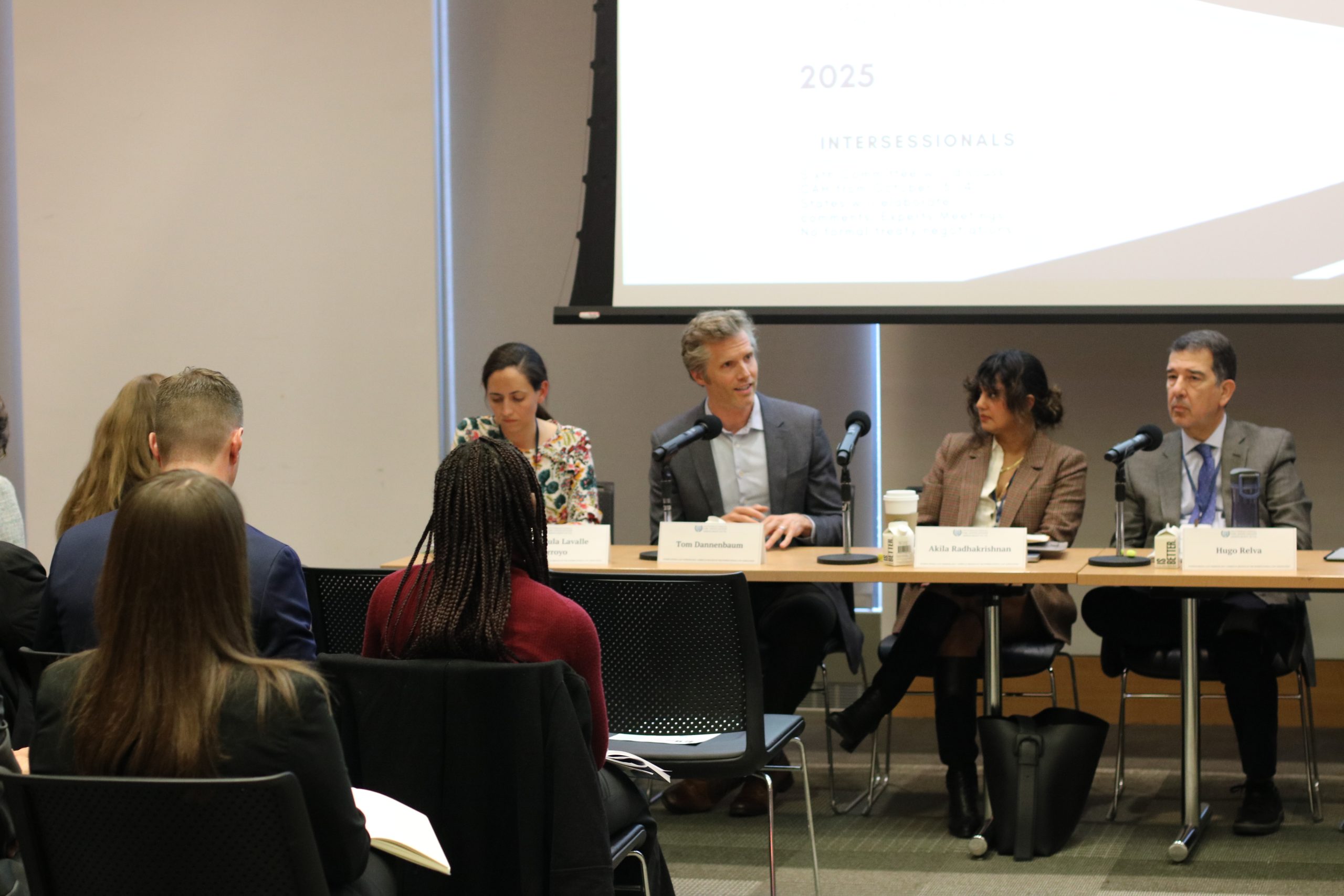
International Law Weekend 2025 (ILW 2025), held from October 23 to 25 in New York City, brought together some of the most prominent figures in international law, including diplomats, scholars, and practitioners, for a dynamic and inspiring three-day conference. The event serves as a leading forum for dialogue, scholarship, and collaboration on the future of international law.
This year’s theme, “Crisis as Catalyst in International Law,” examined how periods of upheaval can serve as moments of transformation, highlighting international law’s capacity to address urgent global challenges. The panel “Negotiating the Future Crimes Against Humanity Treaty: Paradigm Shift or Half-Measure?” exemplified this theme and contributed to the broader discussions shaping ILW 2025.
A bright light amid global uncertainty
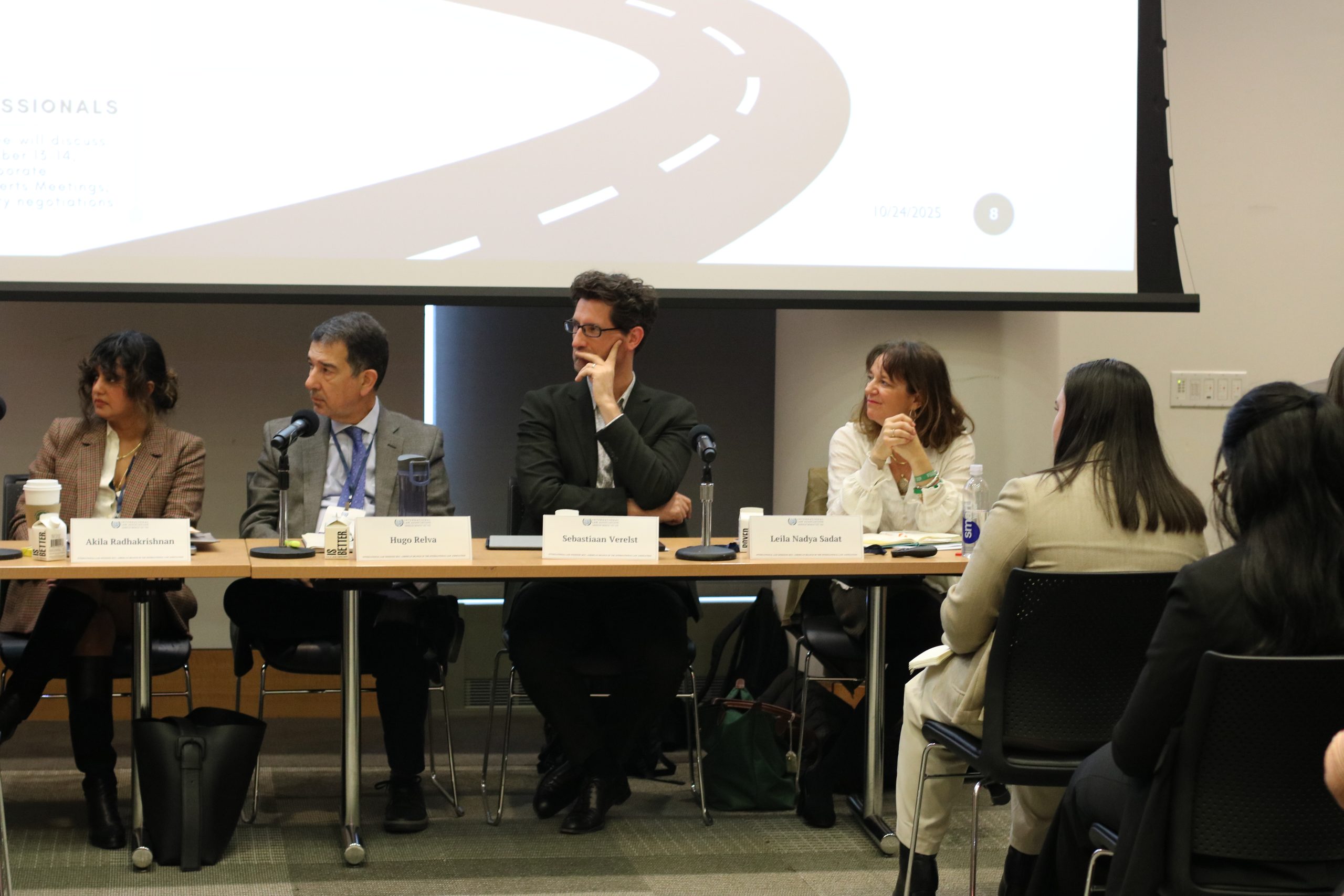
Elinor Hammerskjöld, UN Under-Secretary-General for Legal Affairs, recently described the treaty negotiations on crimes against humanity as “a bright light” amid shrinking UN budgets and growing geopolitical strain. That sentiment captured the spirit of the standing-room-only panel, sponsored by the ABILA Study Group on Crimes Against Humanity and moderated by Professor Leila Nadya Sadat, Chair of ABILA, James Carr Professor of International Criminal Law at Washington University School of Law, and Director of the Crimes Against Humanity Initiative.
The panel examined the path forward for the Convention on the Prevention and Punishment of Crimes against Humanity, following General Assembly Resolution 79/122, adopted without a vote in December 2024, with 192 of 193 Member States in favor. The resolution established a four-year timeline culminating in Diplomatic Conferences in 2028 and 2029. The speakers described the treaty’s progress as a reaffirmation of states’ commitment to the rule of law and their shared responsibility to prevent and punish atrocity crimes. They emphasized the need to carry that commitment forward as negotiations begin. The Preparatory Committee will convene in January 2026.
Voices of momentum and insight
The room was filled with optimism and shared purpose as Professor Leila Sadat opened by walking the audience through how the proposed Convention reached its current stage. She reflected that the excitement surrounding the treaty signaled more than legal progress but also a renewed faith in the world’s capacity to act together for justice and accountability. She stressed that, even in difficult times, the global effort to finalize a crimes against humanity convention stands as proof that nations still believe in the rule of law, human dignity, and the possibility of collective progress.
The panelists shared perspectives spanning diplomacy, academia, and civil society Ana Paula Lavaelle Arroyo, Legal Adviser to the Permanent Mission of Mexico to the United Nations, provided an invaluable on-the-ground perspective from the Sixth Committee. She described the broad engagement of states leading up to the official opening of treaty negotiations and detailed the practical steps that lie ahead.
The negotiation process formally begins in January 2026, when the preparatory committee and working group lay the groundwork by refining draft text, reviewing and incorporating state proposals, and addressing key technical and legal questions. The committee will reconvene in 2027 to continue this work. States are scheduled to gather for a five-week diplomatic conference at UN Headquarters in 2028, followed by a three-week diplomatic conference in early 2029, with the aim of concluding and adopting the convention.
Professor Tom Dannenbaum of Stanford University underscored the need for the future convention to expressly include starvation, noting that the Rome Statute recognizes it as a distinct offense only as a war crime under Art. 8(2)(b)(xxv), and in the context of crimes against humanity, only through the residual category of “other inhumane acts.” The ICC Prosecutor’s application for arrest warrants against senior Israeli leaders includes allegations of starvation, grounded in a pattern of starvation-related conduct. This is significant because starvation has never been prosecuted at the international level. Expressly codifying starvation as a distinct offense in the new convention would be an important development, especially because crimes against humanity can be prosecuted without establishing the existence of an armed conflict. Professor Dannenbaum described starvation as a deliberate and devastating form of mass violence, noting its disproportionate impact on children and pregnant women. He explained that the new convention offers an opportunity to ensure that starvation is fully recognized as a crime against humanity.
(For additional discussion of starvation’s disproportionate impact on pregnant women and children, see UNFPA.)
Akila Radhakrishnan emphasized the importance of integrating gender justice across the convention’s framework. She explained that doing so would help build a gender-competent instrument capable of providing lasting protection for survivors of sexual and gender-based crimes. She called attention to proposals for express recognition of gender apartheid as a crime against humanity, reflecting broader efforts to ensure the convention meaningfully addresses gendered harm.
(See Akila Radhakrishnan & Alyssa Yamamoto on states’ growing support for recognizing gender apartheid in the draft treaty.)
Hugo Relva of Amnesty International highlighted the vital role of civil society organizations, whose expertise and continued engagement will reinforce the treaty’s legitimacy and long-term effectiveness. Sebastiaan Verelst, UN High Commissioner for Human Rights’ Transitional Justice Adviser, connected these discussions to broader questions of implementation, reflecting on how the convention could unify atrocity prevention, accountability, and transitional justice within national systems.
This discussion prompted thoughtful engagement from attendees, many of whom have closely followed the treaty’s development. Questions addressed state cooperation, the role of victims and survivors in shaping the treaty’s final text, and how the proposed convention may complement existing accountability mechanisms. The exchange highlighted both the complexity of the negotiations ahead and the strong international community interest in seeing a comprehensive, practically implemented framework emerge.
ABILA Study Group on Crimes Against Humanity
The panel also marked the launch of the ABILA Study Group on Crimes Against Humanity, a new initiative of the American Branch of the International Law Association that brings together leading scholars and practitioners under the leadership of Professor Leila Sadat.
The study group is reviewing the International Law Commission’s 2019 Draft Articles on the Prevention and Punishment of Crimes Against Humanity and developing recommendations to strengthen the treaty’s language and scope. Its work aims to assist state delegations in preparing for formal negotiations.
Current topics under review include key provisions on persecution, the slave trade, starvation, and environmental destruction, as well as issues of prevention, jurisdiction, modes of liability, and dispute settlement. The Study Group is also examining interrelated themes like civil society participation, children, and gender.
The Study Group’s guiding purpose is to ensure that the final treaty builds on and reinforces the principles of international criminal law reflected in existing instruments and customary law, while advancing its progressive development. This includes drawing on foundational instruments such as the Rome Statute of the ICC, the Genocide Convention, and the jurisprudence of international tribunals such as the ICC, ICTY, and ICTR. The Study Group is also committed to engaging with evolving legal concerns and pressing challenges in international criminal law, including addressing critical gaps such as those already discussed in relation to gender justice, starvation, and other systematic forms of harm.
(Read more about the ABILA Study Group here.)
The road ahead
As the world looks toward the formal opening of the Preparatory Committee in January 2026, enthusiasm continues to build. The coming year is expected to see increased global activity, including at the United Nations, as states prepare their initial positions for the treaty’s formal drafting stage. The panelists noted that the lead-up to the 2026 Preparatory Committee meeting may prove decisive in shaping the scope and ambition of the future convention.
ILW 2025 demonstrated that, despite global uncertainty, the international community continues to engage meaningfully with one of international law’s most consequential projects. In a world where global division can feel especially present, the success of ILW 2025 and the overwhelmingly positive response to the crimes against humanity panel offered something powerful: renewed confidence that law, cooperation, and a shared commitment to justice can still guide us forward.
 *Claire E. Barrington is a JD/LLM student at Washington University School of Law in St. Louis, Missouri, where she is pursuing a dual degree in Law and Negotiation & Dispute Resolution. Before law school, Claire had a nearly decade-long career as a professional ballet dancer, performing with international ballet companies across North America and Europe. Her experiences collaborating with artists from around the world sparked a deep interest in international law and cross-border cooperation. Claire holds dual Bachelor’s degrees in English and Criminal Justice from Miami University (Ohio). At WashU Law, she is a staff editor for the Global Studies Law Review, a research assistant to Professor Leila Sadat in international law, and an active member of the International Law Society.