Event-Women’s Equal and Inclusive Representation in International Law: Learning Lessons and Overcoming Barriers
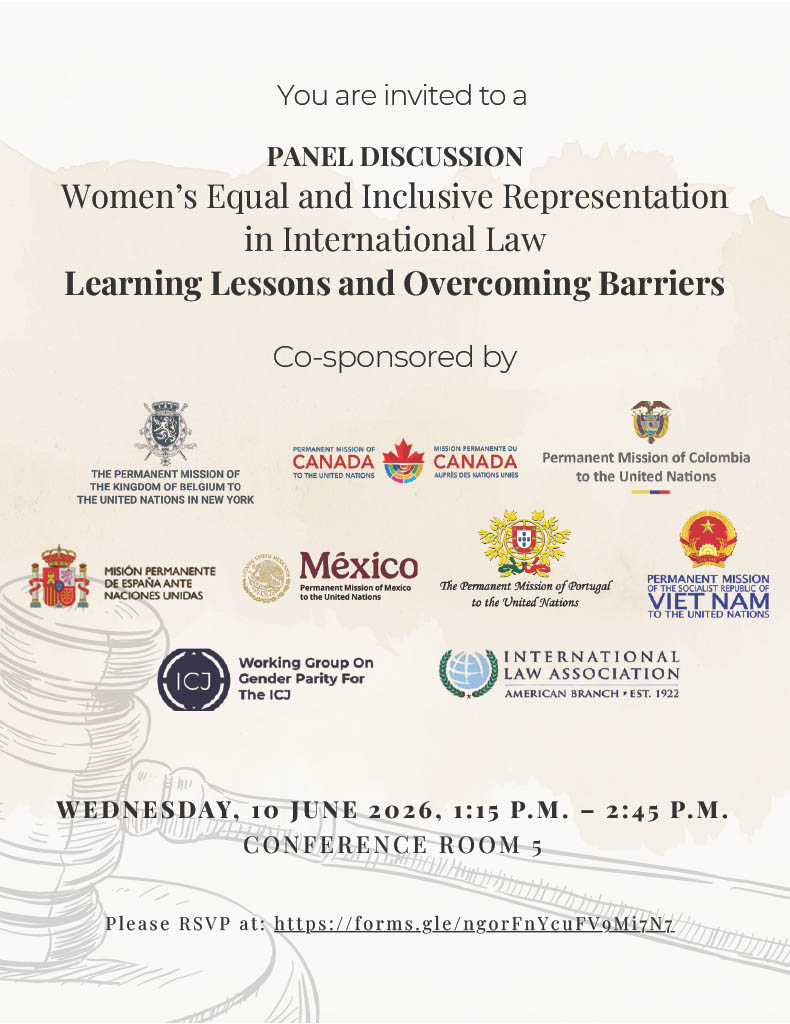
Women’s Equal and Inclusive Representation in International Law:
Learning Lessons and Overcoming Barriers
Wednesday, 10 June 2026, 1:15 p.m. – 2:45 p.m.
Conference Room 5, United Nations Headquarters, New York*
* If need access to building, please indicate in registration form.
CONCEPT NOTE
1. Background
International law plays an indispensable role in maintaining peace and security, promoting sustainable development, protecting human rights, governing the oceans and strengthening the rule of law in international relations. International courts, tribunals, legal institutions and intergovernmental processes contribute to the progressive development, codification, interpretation and application of international law across a wide range of areas, including the peaceful settlement of disputes, international criminal justice, diplomatic and consular relations, environmental protection, climate change, biodiversity conservation and ocean governance.
Women have made important contributions to international law as judges, legal advisers, diplomats, academics, negotiators and institutional leaders. Their leadership has become increasingly visible in international legal forums and negotiating processes, including the International Law Commission, the Sixth Committee of the General Assembly, UNCITRAL and intergovernmental negotiations on new international legal instruments, including the BBNJ Agreement. In the field of ocean governance and the law of the sea, women legal experts have also assumed important roles in negotiations, institutional governance and the interpretation
and implementation of international legal frameworks.
Despite important progress in recent years, women remain underrepresented in many international courts, tribunals and other international legal institutions, including the ICJ, ITLOS, the ILC, the ICC and other relevant bodies. Enhancing women’s participation and leadership in these institutions is not only a matter of gender equality. International legal bodies exercise important responsibilities on behalf of the international community as a whole. Their legitimacy, representativeness and effectiveness are strengthened when their composition reflects a diversity of legal traditions, professional experiences and perspectives, including through the
women’s equal and inclusive participation.
Gender equality in international legal institutions is also firmly anchored in the international normative framework. Article 8 of the UN Charter provides that the United Nations shall place no restrictions on the eligibility of men and women to participate in any capacity and under conditions of equality in its principal and subsidiary organs. Article 8 of the Convention on the Elimination of All Forms of Discrimination against Women calls upon States parties to ensure women, on equal terms with men, the opportunity to represent their Governments at the international level and to participate in the work of international organisations. Sustainable
Development Goal 5.5 and CEDAW’s General Recommendation 40 further call for women’s full and effective participation and equal opportunities for leadership at all levels of decision-making.
The discussion of women’s equal and inclusive participation in international law is particularly timely in the context of forthcoming elections and appointments to international judicial and legal bodies, including those of ITLOS, the ICJ and the ILC. Collectively, such elections shape the representativeness, credibility and long-term effectiveness of international legal institutions.
2. Objectives
Against this backdrop, and building on earlier exchanges among representatives and women legal advisers of Permanent Missions, including the interactive dialogue held on 8 May 2026, this panel discussion aims to provide an informal and interactive platform for States, diplomats, judges, legal practitioners, academics and representatives of relevant civil society/non-intergovernmental organisations to discuss women’s contributions to international law, the importance of equitable representation in international legal institutions and practical measures to strengthen women’s participation and leadership in international legal bodies and processes.
The panel discussion seeks to:
• Highlight women’s contributions to the progressive development, interpretation and implementation of international law, including the law of the sea.
• Take stock of gender representation in international courts, tribunals and other international legal bodies and processes.
• Promote discussion on the relationship between gender equality, diversity, legitimacy and effectiveness in international legal institutions.
• Exchange experiences and best practices on advancing women’s leadership in international adjudication, international legal processes and ocean governance.
• Encourage equitable consideration and broader support for qualified women candidates in elections and appointments to international judicial and legal bodies; and
• Identify practical measures at the national, regional and international levels to strengthen women’s participation and leadership in international law and governance.
3. Guiding Questions
The panel discussion and subsequent open exchange will focus on the following questions:
• What is the current state of gender representation in international courts, tribunals and other international legal bodies, and what challenges continue to limit women’s participation and leadership in these institutions?
• Why does gender equality in international legal institutions matter for their diversity, legitimacy, representativeness and effectiveness?
• How have women contributed to the progressive development, codification, interpretation and implementation of international law, including through the International Law Commission, the Sixth Committee of the General Assembly and other relevant legal processes?
• What role have women played in ocean governance and the implementation of the law of the sea, including through leadership positions in the negotiation and implementation of the BBNJ Agreement, ITLOS, the International Seabed Authority and other relevant bodies and processes?
• How can States, international organisations, academic institutions and professional networks better support the next generation of women international lawyers, judges, arbitrators and negotiators?
• What concrete measures can be taken at the national, regional and UN levels to promote gender equality and strengthen women’s representation and leadership in international judicial bodies, legal institutions and international legal processes, including in the context of elections and appointments?
Tentative Programme
1:15 – 1:25 • Welcome and opening remarks by H.E. Ambassador Đỗ Hùng Việt, Permanent Representative of Viet Nam
• Keynote speech by Mr. Steven Hill, Assistant Secretary-General for Legal Affairs, UN Office of Legal Affairs
1:25 – 2:15 Panel discussion moderated by Ambassador Bart De Wolf, Deputy Permanent Representative of Belgium
● Dr. Jessica Lynn Corsi, Co-Founder, Working Group on Gender Parity, Co-Chair, ABILA Gender Justice in International Law Committee: Introductory presentation: gender representation in international legal institutions, reflections and recommendations on the way forward
● Professor Jelena Pia-Comella, Independent Expert, Committee on the Elimination of Discrimination Against Women (CEDAW)
● Professor Margaret Satterwhaite, UN Special Rapporteur on the independence of judges and lawyers
● Ms. Estela Mercedes Nze Mansogo, Vice-Chair of 6th Committee (Legal) of 80th UNGA session
● Women members or former members of an international court, tribunal or other international legal institution (TBC)
2:15 – 2:40 Interactive discussion moderated by Ambassador Bart De Wolf, Deputy Permanent Representative of Belgium
● Interventions by representatives of co-sponsors
• Open floor for all attending delegates
2:40 – 2:45 Concluding remarks by Ambassador Ana Jiménez de la Hoz, Deputy Permanent Representative of Spain
All Permanent Representatives, Deputy Permanent Representatives, Legal Advisers and Elections Officers of the Permanent Missions and Observer Missions to the United Nations, as well as legal practitioners, academics, law of the sea experts and representatives of relevant organisations, are cordially invited to attend the panel discussion. The panel discussion will be conducted in English, without interpretation. A light lunch will be served for all attending delegates.
Register here or by clicking the poster above.