EVENT – Women’s Equal Right to Participate in the Judiciary and Women’s Access to Justice: More Women, More Access
CONCEPT NOTE
70th Session, United Nations Commission on the Status of Women Side Event
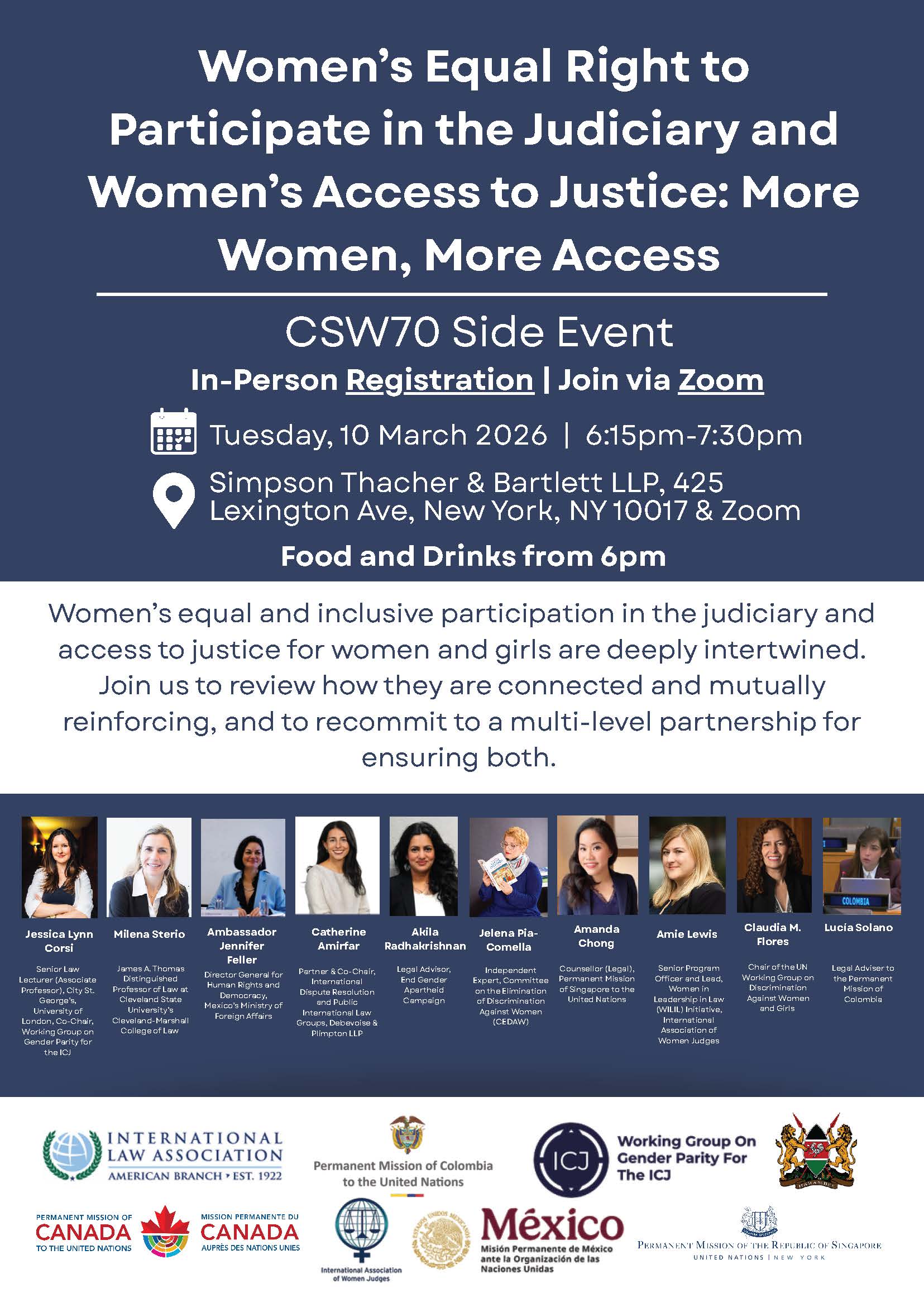
Women’s Equal Right to Participate in the Judiciary and Women’s Access to Justice: More Women, More Access
Tuesday 10 March | International Day of Women Judges | 6:15-7:30 pm
Location: Simpson Thacher & Bartlett LLP, 425 Lexington Ave, New York, NY 10017 | Zoom Link
Food and beverages provided from 6pm
Background
Access to justice is a fundamental human right,[1] and States are obligated to ensure access to justice for women and girls.[2] Globally, women and girls face numerous gendered barriers to justice, whether as claimants, witnesses, victims, or defendants. Relatedly, the right to equal and inclusive participation in decision making, including the judiciary, is a fundamental human right, and States have a responsibility to appoint women to judicial roles at all levels of the judiciary.[3] Yet, around the world, men often comprise the majority of judges in domestic, regional, and international courts, particularly in the most senior judicial roles.
Women’s equal and inclusive participation in the judiciary and access to justice for women and girls are linked in several ways. The CEDAW Committee has noted that ‘[w]omen’s equal participation in the judiciary is part of what makes access to justice meaningful’ and that ‘[i]f the judiciary lacks equal participation, the system’s credibility and legitimacy are compromised’.[4] Observing that ‘gender stereotyping by judges is a “core impediment” to access to justice,’[5] the Committee called for States Parties to remove barriers to access to justice, including by ‘confront[ing] and remov[ing] barriers to women’s participation as professionals within all bodies and levels of judicial and quasi-judicial systems and providers of justice-related services.’[6]
Similarly, the Special Rapporteur on the Independence of Judges and Lawyers stated that ‘discrimination against women stems not only from certain explicit regulatory obstacles but also from institutional, structural and cultural barriers that lead to underrepresentation in public decision-making positions or confinement to certain areas of the judicial system.’[7]The Office of the High Commissioner for Human Rights noted that ‘[i]ncreased representation of women within the police and the judicial system as well as mainstreaming gender within the judiciary can also improve their responsiveness to gender issues and make it easier for women to seek assistance or report their cases.’[8]
Further, UN Women has observed that ‘[w]omen’s representation in the judiciary is a matter of equality and fairness, but it is also important for maintaining public confidence in the justice system. There is evidence that women judges can create more conducive environments for women in courts and can make a difference to outcomes.’[9] UNDP and UN Women have together found that there is ‘evidence that women judges are less susceptible to corruption, and their effective representation in the judiciary increases trust in the system,’[10] and that ‘[t]he mere presence of women judges enhances the legitimacy of courts, sending a powerful signal that they are open and accessible to all who seek justice’.[11]
Against this backdrop, and recalling CSW 70’s priority theme of ‘[e]nsuring and strengthening access to justice for all women and girls, including by promoting inclusive and equitable legal systems, eliminating discriminatory laws, policies, and practices, and addressing structural barriers,’ this side event aims to converge States, UN bodies, international and regional organisations, civil society, and other key stakeholders to discuss the connections between increasing gender equality for the judiciary and increasing access to justice for women and girls. Building on our previous side events focused on achieving gender parity for judges at the International Court of Justice,[12] this event invites participants to commit to achieving women’s equal and inclusive participation in the judiciary, both as a fundamental human right in itself, and as a pathway for increasing access to justice for women and girls and strengthening the protection of human rights for all.
Structure of the event:
This is an in-person roundtable dialogue moderated by Dr. Jessica Lynn Corsi and Professor Milena Sterio. Observers may join by Zoom (Link here), and all attendees are invited to contribute following the prepared interventions.
6:00 pm food and beverages provided
6:15 pm Welcome and introduction of the topic by Dr Jessica Lynn Corsi, Associate Professor of Law, City St George’s, University of London, and Co-founder and Co-Chair, Working Group on Gender Parity for the ICJ
6:30 pm Prepared interventions
1) Ambassador Jennifer Feller, Director General for Human Rights and Democracy, Mexico’s Ministry of Foreign Affairs
2) Catherine Amirfar, Partner & Co-Chair, International Dispute Resolution and Public International Law Groups, Debevoise & Plimpton LLP
3) Ms. Akila Radhakrishnan, Legal Advisor, End Gender Apartheid Campaign
4) Professor Jelena Pia-Comella, Independent Expert, Committee on the Elimination of Discrimination Against Women (CEDAW)
5) Amanda Chong, Counsellor (Legal), Permanent Mission of Singapore to the United Nations
6) Ms. Amie Lewis, Senior Program Officer and Lead, Women in Leadership in Law (WILIL) Initiative, International Association of Women Judges
7) Claudia M. Flores, Chair of the UN Working Group on Discrimination Against Women and Girls
8) Lucía Solano, Legal Adviser to the Permanent Mission of Colombia
Roundtable dialogue:
Attendees are invited to make interventions and raise questions and discussion points.
7:15 pm: Concluding remarks:
Professor Milena Sterio, James A. Thomas Distinguished Professor of Law at Cleveland State University’s Cleveland-Marshall College of Law, Managing Director at the Public International Law & Policy Group, Steering Committee Member, Working Group on Gender Parity for the ICJ
7:30 pm Drinks and mingle
Organised by the Working Group on Gender Parity for the ICJ and the ABILA Committee on Gender Justice in International Law
Co-sponsored by the Permanent Mission of Canada, the Permanent Mission of Colombia, the Permanent Mission of Kenya, the Permanent Mission of Mexico, the Permanent Mission of Singapore, the Permanent Mission of Sweden, and the International Association of Women Judges
With support from UN Women UK
Kindly hosted by Simpson Thacher & Bartlett LLP
[1] UDHR, Arts 8, 10; ICCPR Art 14.
[2] CEDAW Arts 2, 15; UDHR Arts 2, 7.
[3] CEDAW Arts 7, 8; CEDAW GR 40 2024 paras 18, 49, 52, 53, 56, 72; CEDAW GR23 1997, paras 26, 29.
[4] CEDAW GR33 2015, para 1.
[5] CEDAW GR33 2015, para 26.
[6] CEDAW GR33 2015, para 15(f); see also CEDAW GR30 2013 para 56(c).
[7] A/76/142: Participation of women in the administration of justice – Report of the Special Rapporteur on the independence of judges and lawyers, Diego García-Sayán, para 17.
[8] Women’s Rights are Human Rights, HR/PUB/14/2, 2014, p. 117.
[9] UN Women, Progress of the world’s women: In pursuit of justice, 2011, p. 61.
[10] UNDP and UN Women, Women in Justice in Africa, 2023, p. 4.
[11] UNDP and UN Women, Women in Justice in Africa, 2023, p. 6.
[12] CONCEPT NOTE, 79th Session, United Nations 6th Committee Expert Roundtable Side Event, More Women, But Not Enough Women: Achieving Gender Parity for Judges at the International Court of Justice, 24 October 2024, https://www.un.org/en/ga/sixth/79/pdfs/events/25_october_2024_7cn.pdf; CONCEPT NOTE, 80th Session, United Nations 6th Committee Expert Roundtable Side Event, The Right to Equal and Inclusive Participation and the International Court of Justice: Where are the Women?, https://www.un.org/en/ga/sixth/80/pdfs/events/31_october_2025_4cn.pdf.